

Is your insulation budget hitting a brick wall? 🧱💸

Why More Isn't Always Better: The Law of Diminishing Returns in Insulation
Most Australian homeowners think that doubling their insulation R-value means doubling their comfort. But there’s a secret the "big box" stores don't always mention: The Law of Diminishing Returns.
Going from no insulation to R2.0 is a game-changer. But jumping from R5.0 to R7.0? You might be spending thousands for just a tiny 1–2% improvement in thermal performance. 📉
When building or renovating in Australia, the conversation usually starts and ends with: "What’s the R-value?" While it’s true that insulation is the backbone of a comfortable home, there is a common misconception that doubling your R-value doubles your protection.
In reality, insulation performance follows the Law of Diminishing Returns. If you’re aiming for a 7-star NatHERS rating or just trying to slash your energy bills, understanding this curve is vital for your budget.
What is an R-Value?
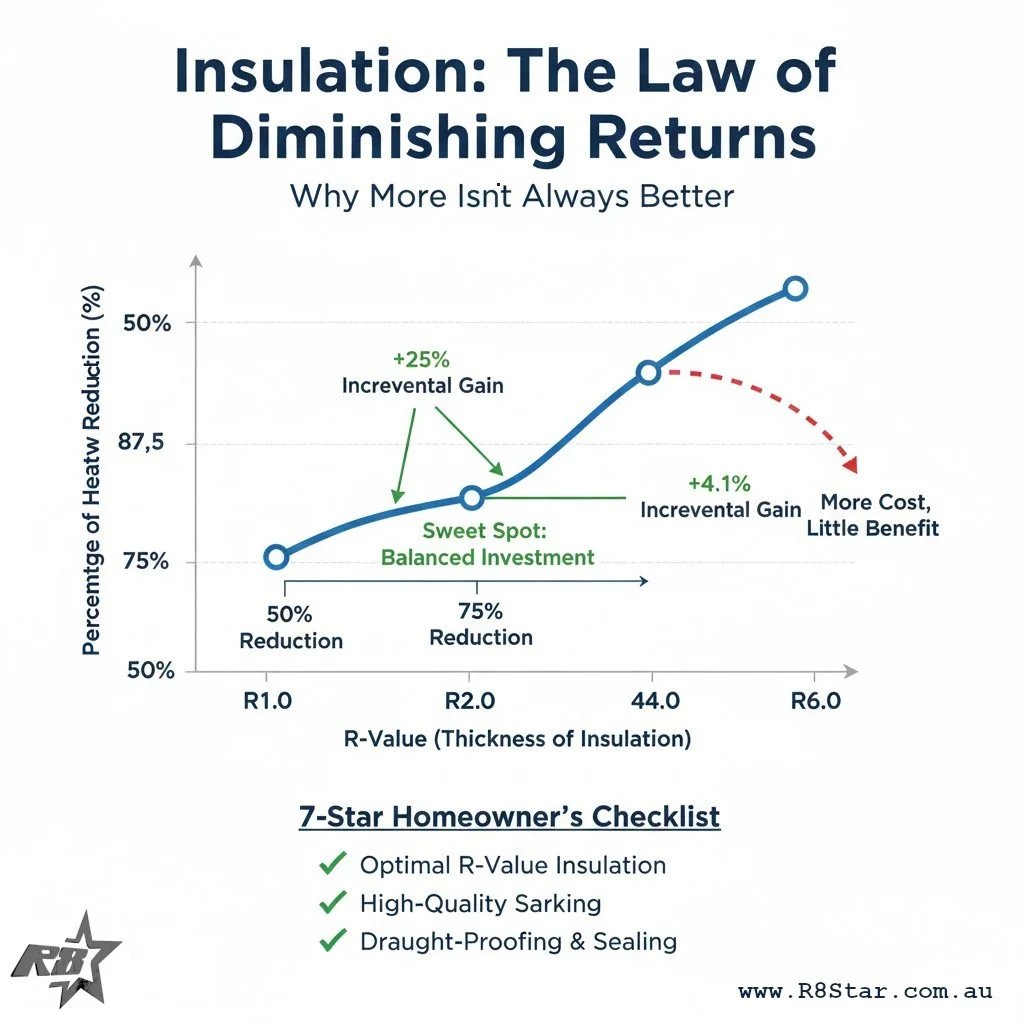
In simple terms, an R-value measures a material’s resistance to heat flow. The higher the number, the better the insulator. However, the relationship between the thickness of the insulation and the heat it stops isn't a straight line—it’s a curve.
Think of insulation like wearing jackets in the winter:
The First Jacket 🧥: You go from freezing to relatively warm. Huge benefit.
The Second Jacket 🧥🧥: You’re now quite toasty. Good improvement.
The Tenth Jacket 🧥🧥🧥🧥🧥🧥🧥🧥🧥🧥: You’re barely warmer than you were with nine, but you’ve spent a lot more money and can no longer move your arms.

The Math of Heat Transfer
To understand why this happens, we look at how much heat actually gets through. The percentage of heat flow reduction is calculated using the reciprocal of the R-value ($1/R$).
R-Value Heat Flow Reduction Incremental Gain
R1.0 50% Base
R2.0 75% +25%
R4.0 87.50% +12.5%
R6.0 91.60% +4.1%
Why This Matters for Your Build
1. The "Weakest Link" Rule
Insulation is only as good as the rest of the building envelope. If you install R7.0 batts in the ceiling but have standard single-glazed windows or gaps under your doors, the heat will simply bypass your expensive insulation. We call this thermal bridging and air leakage.
2. Space Constraints
In many Australian wall cavities, you only have 90mm of space. Trying to cram an R-value that is too high for the physical space can actually compress the material, which reduces its effectiveness. Insulation needs trapped air to work.
3. Cost-Benefit Analysis
In milder Australian climates (like parts of NSW or QLD), the "sweet spot" is often lower than in the alpine regions. Spending your budget on high-quality sarking, double glazing, or draught-proofing often yields a better NatHERS star rating than simply chasing the highest R-value available.
The Bottom Line
Don't just chase the biggest number on the bag of insulation. A balanced approach to the entire building envelope is what creates a truly energy-efficient home.
As thermal performance assessors, we look at the whole picture—orientation, glazing, and insulation—to find the point where your investment meets the highest possible comfort.