

🌡️ What is a U-Value?
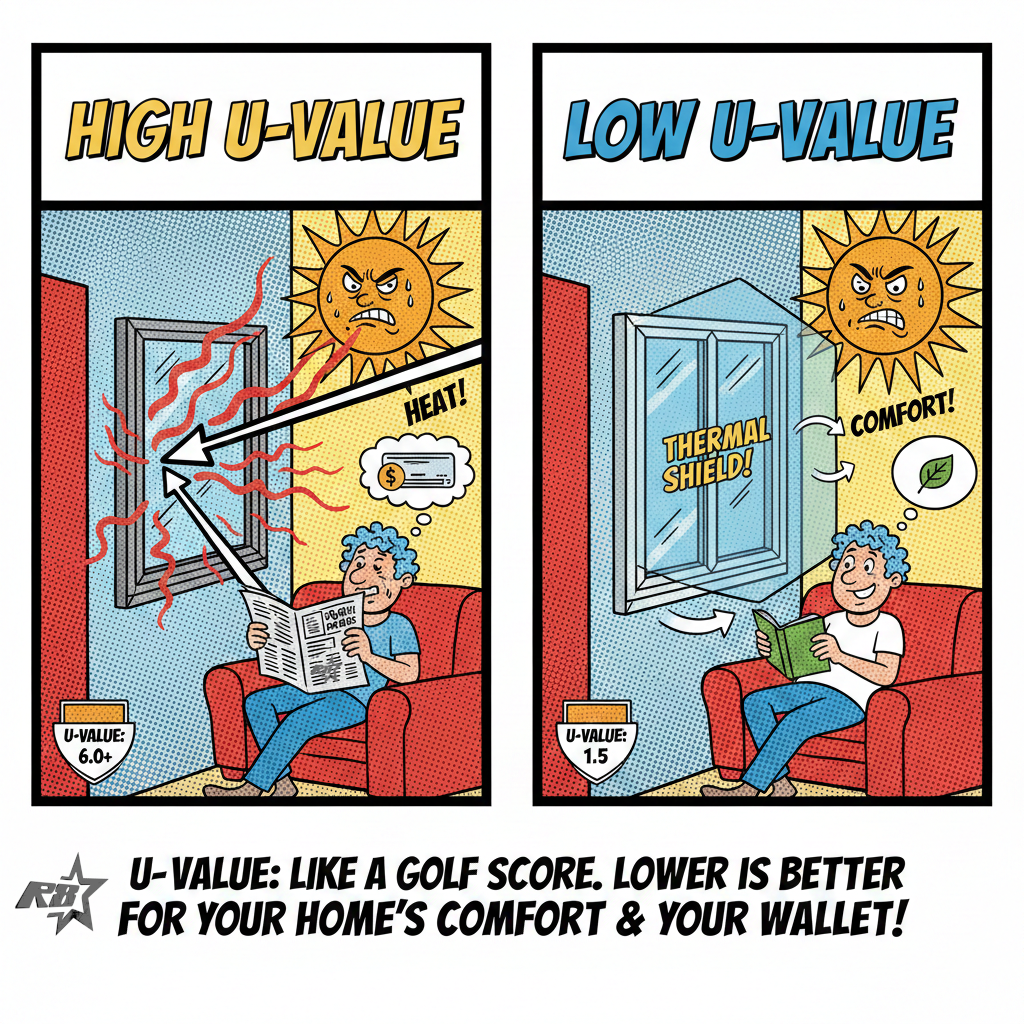
In simple terms, the U-value measures how much heat leaks through your window. It’s the "leakiness" factor.
Unlike R-values (used for wall insulation), where a higher number is better, U-values work like a golf score: lower is better. * A high U-value means your windows are essentially "thermal holes" in your walls.
A low U-value means your windows are acting like a thermal shield, keeping your expensive air conditioning or heating inside where it belongs.
The "Whole Window" Trap
In Australia, we calculate the U_{w} (Whole Window Value). This is crucial because heat doesn't just travel through the glass; it also pours through the frame. A high-performance pane of glass in a cheap, un-insulated aluminium frame will still have a poor (high) U-value.
⭐ The Connection to NatHERS (Star Ratings)
You’ve likely heard that new Australian homes now aim for a 7-Star NatHERS rating.
NatHERS (Nationwide House Energy Rating Scheme) doesn't just look at your insulation; it simulates how your house "breathes" 24/7. Because windows are usually the weakest point in a building's "envelope," they have a massive impact on your stars.
Window Type Typical U-Value (W/m2K) Impact on NatHERS
Standard Single Glazed 6.0+ Makes hitting 7 stars very difficult; high heat loss/gain.
Standard Double Glazed 3.0 – 4.0 The "new normal"; significantly improves comfort.
High-Perf. Double Glazed 1.0 – 2.5 The "Gold Standard"; helps reach 7–10 stars easily.
Pro Tip: Upgrading your windows from a U-value of 6.0 to 3.0 can sometimes boost your home's rating by 1 full star or more without changing anything else in the design!
🏡 Why Should You Care?
It’s not just about passing a government test. A low U-value window directly affects your Thermal Comfort:
No "Cold Zone": You can sit next to a window in winter without feeling a draft.
Lower Bills: Your HVAC system doesn't have to work overtime to fight the heat coming through the glass.
Less Condensation: High-performance windows (like uPVC or thermally broken aluminium) reduce the "crying windows" effect that leads to mould.
🚀 Ready to level up your build?
The next time you look at a NatHERS Certificate, look straight at the WERS (Window Energy Rating Scheme) Numbers.
Or just talk to us at www.R8Star.com.au