NCC 2025 Volume 2 BASIX Changes
There IS an option for Verification using a reference building. (H6V2 in the NCC Vol 2)
HOWEVER:
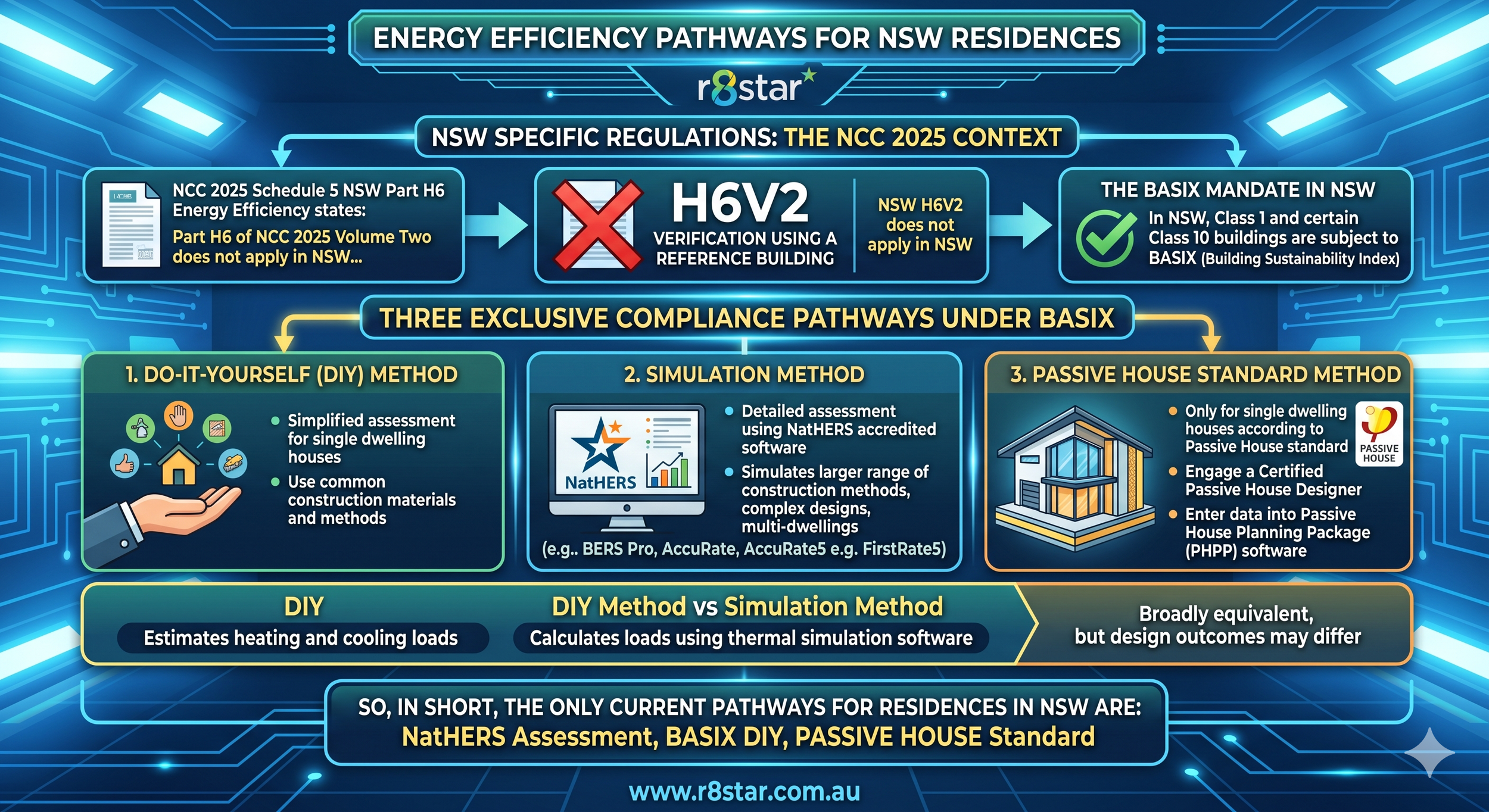
NCC 2025 Schedule 5 NSW PartH6 Energy Efficiency states:
"Part H6 of NCC 2025 Volume Two does not apply in NSW and NSW Part H6 of NCC 2022 Volume Two Amendment 2 applies in NSW."
Which in turn states:
NCC 2022 Schedule 5 NSW Part H6 Energy Efficiency states:
"NSW H6V2 Verification using a reference building H6V2 does not apply in NSW"
and:
In NSW, Class 1 buildings and certain Class 10 buildings are subject to BASIX (the Building Sustainability Index)
And The BASIX ONLY provides the following options:
Thermal performance methods
To complete the Thermal performance section of BASIX, you will need to select one of the following methods:
Do-It-Yourself (DIY) method - simplified assessment for single dwelling houses that use common construction materials and methods
Simulation method - detailed assessment that uses National House Energy Rating Scheme (NatHERS) accredited software, and can simulate a larger range of construction methods and materials, more complex designs and multi-dwelling developments such as townhouses and apartments.
Passive House standard method – This method only applies to single dwelling houses designed and constructed in accordance with the Passive House standard. You need to engage a Certified Passive House Designer to enter the building design information into the Passive House Planning Package (PHPP) software.
The DIY and Simulation method are broadly equivalent across a large sample of dwellings. However, design and compliance outcomes are likely to be different. This is because the DIY method estimates the heating and cooling loads, whereas the Simulation method calculates the loads using thermal simulation software.
So, in short, currently a NatHERS assessment/A BASIX DIY/ Passive house are the only pathways for residences in NSW.