

Things I Learnt Learning NatHERS for Existing Homes (Newcastle Edition)
If you’ve ever wondered how energy efficiency is measured in Australian homes, you’ve probably heard of the Nationwide House Energy Rating Scheme (NatHERS). While we usually hear about it for new builds, the scheme is now rolling out to assess the energy performance of existing homes.
Diving into the training materials to become an assessor has been eye-opening, especially when applying the rules to our local area in Newcastle, NSW 2290. Here are the most fascinating things I’ve learnt about how our homes are rated!
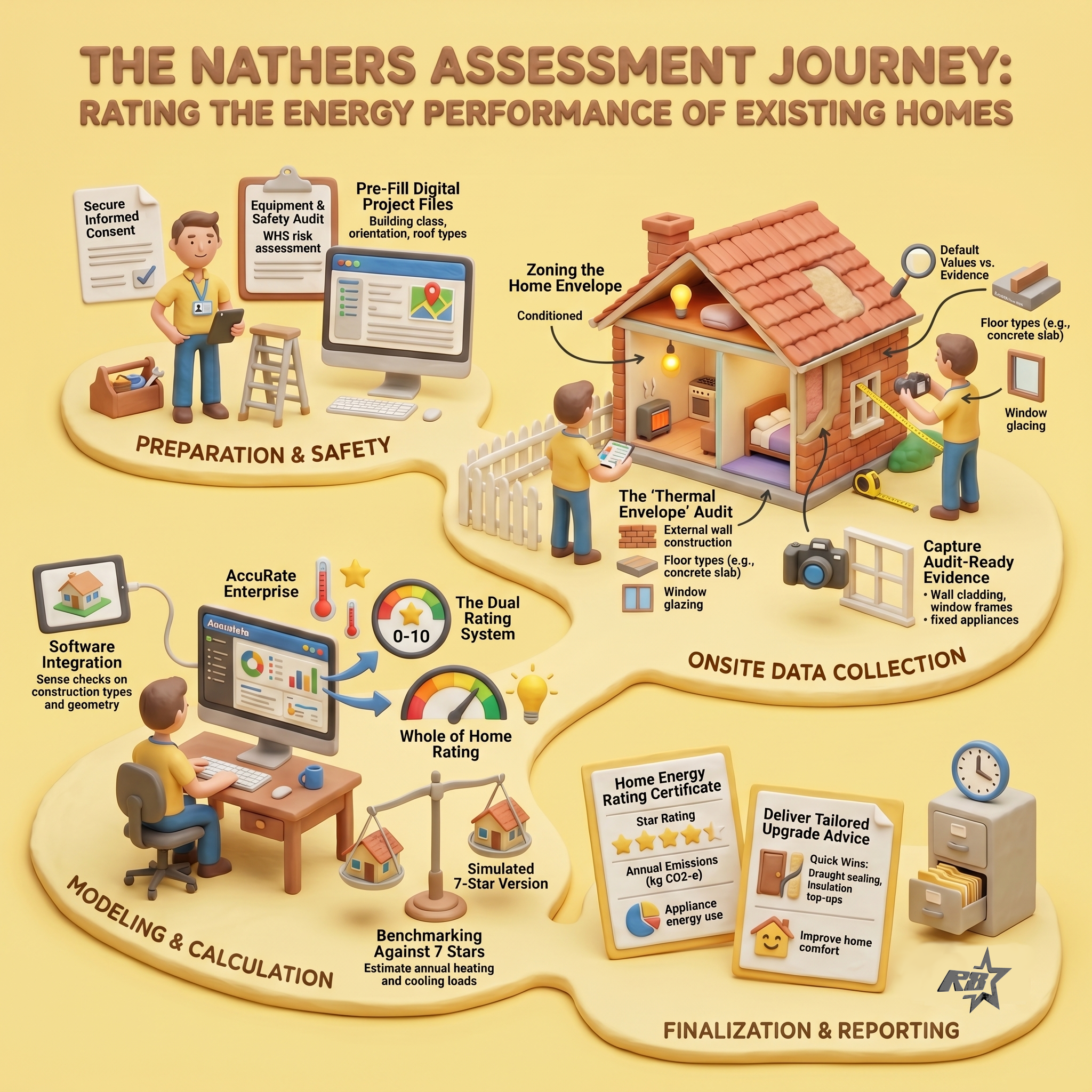
NatHERS for Existing Homes Newcastle and Hunter
1. Our Newcastle Postcode Dictates the Defaults In the NatHERS system, if an assessor can't visually verify something like the insulation inside your walls, they are forced to use "default values". These defaults are incredibly conservative to ensure fair comparisons between homes. Because Newcastle is located in NCC Climate Zone 5, if your home was approved for construction before 2005 and we can't see the insulation, the software automatically assumes you have a mere R1.0 in your ceiling and absolutely zero insulation in your walls or floors.
To avoid these punishing defaults and get a better rating, an assessor needs visual evidence or documentary proof, like an invoice from an insulation installer. Furthermore, for any Class 1 dwelling in NSW built from 2005 onwards, you actually need to provide formal documentation (like council plans) to prove the year of construction approval. Also, for Whole of Home assessments, postcode 2290 places Newcastle in "Zone 3" for calculating the performance (STCs) of air-source heat pumps and solar water heaters.
2. Assessor Safety is Highly Regulated (And We Don't Crawl in Roofs) I always pictured energy assessors arm-crawling through dusty, spider-filled roof cavities. It turns out, assessor safety is a massive priority. We are only required to assess ceiling insulation from the access hatch while remaining safely on a ladder.
3. Privacy and Evidence go Hand-in-Hand Assessors have to take dozens of highly specific photographs—from the external wall cladding and window frame materials to the floor coverings—to prove the home's features,. However, because we are working in lived-in homes, privacy rules are ironclad.
Before an assessment can even begin, the assessor must obtain written consent from the householder (and the tenant, if the property is rented),. If occupants are home during the inspection, at least one person present must be 15 years or older. Crucially, while we take many photos to justify our ratings, these photos must strictly exclude any personal information, such as family portraits or private documents.
4. The Whole of Home energy Rating Goes All the Way to 150. Now While we are used to the classic 0-to-10 Star Rating for a home's thermal shell, NatHERS has expanded to include a Whole of Home energy rating on a scale from 0 to 150. This broader rating factors in the energy used by fixed appliances like your heating, cooling, hot water systems, pool pumps, lighting, and cooking,.
A score of 100 represents a "net zero energy value" home, meaning it generates as much energy as it consumes over a year. Ratings above 100 are entirely possible if a home has an oversized rooftop solar PV and battery system that exports more energy to the grid than the home uses,.
5. The Ultimate Goal: Better Upgrades Ultimately, the purpose of a NatHERS existing home assessment isn't just to give a house a score. The resulting Home Energy Rating Certificate comes with a tailored Upgrade Guidance page. By looking at the home's specific shortfalls and the local climate zone, this guidance empowers Newcastle households with actionable advice to reduce energy bills, lower greenhouse gas emissions, and make the home much more comfortable to live in during extreme weather.